The work that shapes us
 Benny Andrén
The dishwasher test: What five ordinary moments taught me about the AI productivity gains organisations keep losing
One of the questions I find myself returning to most often these days is where all the individual productivity gains from AI are actually going, once they hit an organisation.
The past couple of years I’ve been writing faster, analysing faster and prototyping ideas that would previously have taken days in a matter of hours. Judging by the conversations I have with friends and colleagues, I’m far from alone. Yet relatively few organisations seem to have changed at the same pace. The gap between what individuals can suddenly do and what organisations can collectively achieve feels much larger than I expected. I don’t think that gap shows up in a spreadsheet first. It shows up in small moments — the ones easy to wave off as unrelated to work at all.
A few weeks ago I was invited onto a podcast together with a friend to discuss exactly that question.
We spent most of the conversation trying to understand where those productivity gains go. We talked about incentives, organisational design and coordination. Then, somewhere in the middle of the discussion, my friend made an observation that seemed only loosely connected to any of it.
“The last decade we’ve become obsessed with making everything frictionless.”
He followed it with an example that made everyone around the table laugh. At his company he encourages everyone on the team to take the stairs instead of the lift whenever they can.
Nobody challenged him on it. I joked that part of the satisfaction comes from finally stopping at the top and feeling that you’ve earned the rest. Somehow that reminded me of music, where harmony only really feels satisfying because it’s preceded by tension and dissonance. We laughed, the conversation drifted back to AI and, by the time the recording finished, I didn’t think much more about it.
Over the following weeks, though, his comment stayed with me. Usually it surfaced around something entirely unrelated.
One evening it was my daughters.
I’ve occasionally tried introducing them to some of the games I grew up with. The Secret of Monkey Island. The Legend of Zelda. Games that were perfectly comfortable letting players get lost. Monkey Island never seemed particularly concerned with whether I already knew what to do next. Sometimes the solution was wonderfully logical. Sometimes it involved a rubber chicken and a pulley. The point was simply that the game trusted me to keep trying.
They usually humour me for a while before returning to Roblox or Toca Boca. I don’t blame them. Roblox does something those older games rarely managed. It gets them playing together within seconds.
My first instinct was to dismiss my reaction as nostalgia. Every generation seems convinced that the games they grew up with were somehow better, and I’m old enough to know that memory has a habit of smoothing over the frustrating parts.
Modern games are, by almost every measure I can think of, better designed. They’re better at teaching new players, better at communicating their rules and much better at making sure curiosity survives those first awkward hours when nothing quite makes sense. If someone asked me to design a game for my daughters today, I’d borrow far more ideas from Roblox than from Monkey Island.
Even so, it wasn’t really about difficulty. Plenty of modern games are difficult. I think it’s about the role that uncertainty plays. Older games often expected players to spend time with it. Modern games generally work much harder to make sure it doesn’t linger for long.
A few days later I was cooking dinner.
Cooking has become one of my favourite ways to spend time with family and friends. Not because it’s the fastest way to get food on the table, but because I genuinely enjoy the process. If everyone’s tired after a long day, we’ll happily order takeaway. Convenience has its place, and I’m grateful for it.
What I enjoy about cooking isn’t the end result alone. I like deciding what to make before I even step into the kitchen. I like tasting as I go, realising halfway through that the potatoes should have gone on twenty minutes earlier and trying to recover before anyone notices. I like discovering we’re missing an ingredient and improvising with whatever happens to be in the cupboard. Some of those decisions make the meal better. Others probably don’t. Either way, I’d miss them if they were removed from the experience.
Why did this feel so different from ordering food from a restaurant that could almost certainly have cooked a better meal than I was about to serve?
It wasn’t a question I felt any urgency to answer. If anything, I found it mildly irritating. I’d started with a conversation about AI and organisational productivity, and somehow I’d ended up wondering why I enjoyed cooking dinner.
Then I thought about hiking.
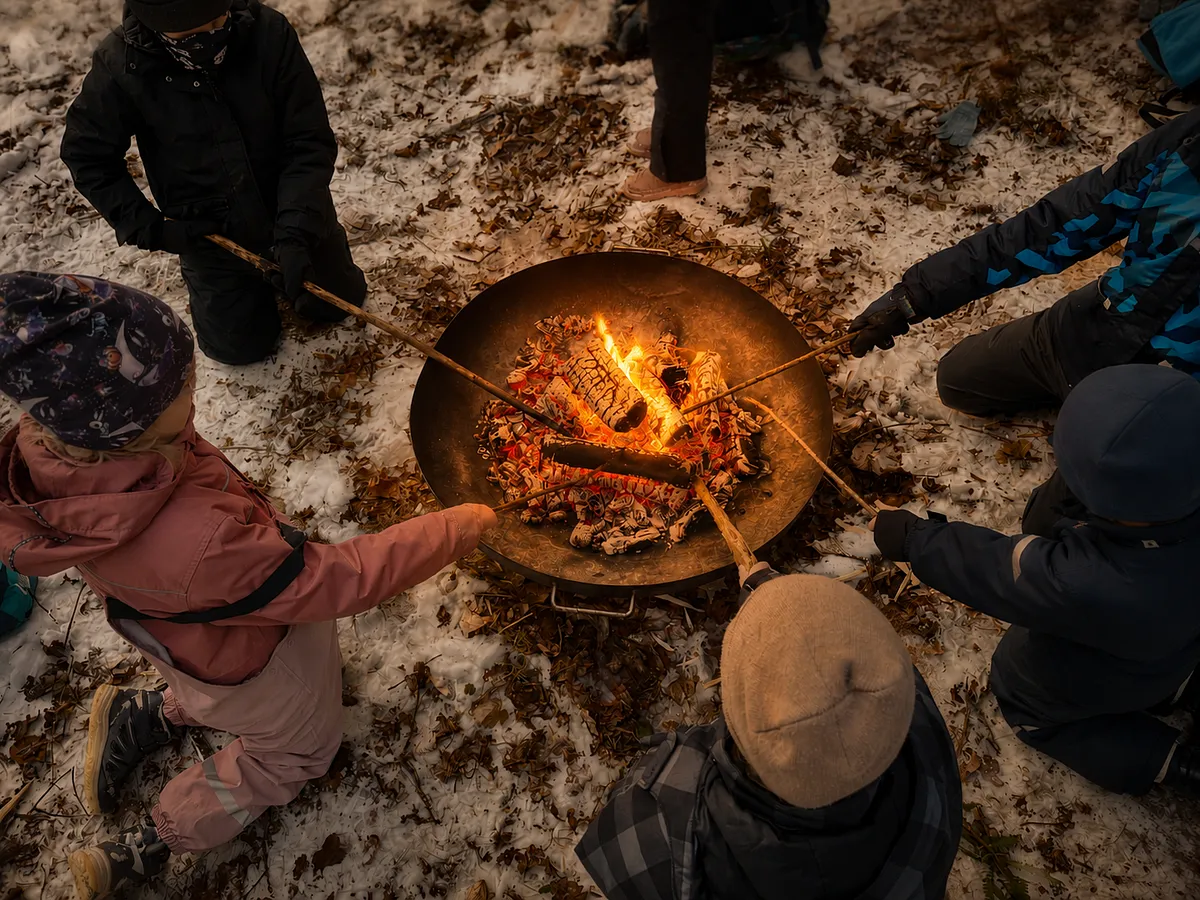
I’ve been involved with scouting for the past few years, and there’s one pattern I’ve seen often enough that I almost expect it. The second day is usually the hardest. Everyone is tired, someone has blisters, somebody decides their backpack has mysteriously doubled in weight and, every now and then, someone cries. It isn’t dramatic and it certainly isn’t constant, but there’s usually a point where the group’s energy seems to disappear all at once.
Until then I never questioned what happened next. We’d stop walking, some of the scouts would collect firewood, others would fetch water, someone would start chopping vegetables while another group wrestled with the camping stove. Half an hour later everyone seemed happier again. I’d always assumed the explanation was simple enough. We’d stopped walking, dinner was on the way and people finally had a chance to rest.
But looking back, I don’t think that’s what I was seeing. The scouts were still tired, tomorrow’s hike hadn’t become any shorter and, if anything, we’d just created more work. There was wood to collect, dinner to cook, tents to pitch and washing up to do before anyone could think about going to bed. Yet somewhere during that process the atmosphere almost always changed. It didn’t seem to coincide with dinner finally being ready or everyone sitting down around the fire. If I had to guess, the shift came earlier than that. Somewhere between the first armful of firewood and the moment when everyone had found something useful to do, the mood would begin to lift. I’d seen that happen dozens of times. I’d simply never stopped to think about it until now.
Years earlier I’d read a paper by the psychologist Robert White. I can’t remember now where I first came across it. White wasn’t writing about AI, game design or scouting. He was trying to understand something much more fundamental: why people seem to enjoy influencing the world around them. His conclusion was that we have an innate drive to discover that our actions make a difference. He called it effectance motivation. The term never really stuck with me. But the idea did.
Reading the paper again, I realised it wasn’t giving me an answer so much as helping me ask a better question. Up to that point I’d been treating all effort as though it belonged in the same category. Technology either removed it or it didn’t. But waiting in a telephone queue, practising a Bach prelude and cooking dinner all require effort, yet they leave behind completely different memories. That was the distinction I’d been missing — not whether something took effort, but what the effort left behind.
I thought back to my own years of practising classical guitar. I don’t think the concerts explain why I kept practising. If they did, I would probably have stopped long before I ever played one. Most of my time was spent alone in a practice room, repeating the same passages over and over again and trying to persuade my fingers to do something they simply weren’t capable of doing the week before. Many days there was very little sense of progress. You played the same notes, made the same mistakes and wondered whether anything was changing at all. Then, every now and again, you’d pick up the guitar and realise that something which had felt completely impossible a month earlier had quietly become possible. Nobody else would have noticed unless they already knew the piece, but that hardly mattered. Those moments remain among the most satisfying learning experiences I can remember, and I don’t think they can be explained by the concert that eventually followed months later.
The dishwasher was the first obvious counterexample.
I don’t particularly enjoy washing plates, and I don’t feel any less connected to dinner because a machine takes care of them afterwards. The same goes for online banking, central heating and a long list of other conveniences that I’d happily keep. If my idea couldn’t explain why those felt fundamentally different from cooking or practising guitar, then it probably wasn’t much of an idea.
There’s a well-known idea in behavioural economics, the IKEA effect, that we value things more once we’ve put labour into them. If that were the whole story, I should feel something extra about hand-washed plates. I don’t. The dishwasher gives me exactly what I want: clean plates. I don’t feel that I’ve lost anything important by letting the machine do the work. Cooking doesn’t feel like that. Practising guitar didn’t feel like that either. The point was never simply to arrive at dinner or to play the piece correctly. Those activities seemed to be changing me long before they produced anything worth showing someone else.
That thought brought me back to AI, the first technology since the internet that has made me stop and pay attention in this way. I write faster, explore ideas faster and get past the blank page with far less resistance than I used to. These tools are remarkable, and I use them every day.
Then one day I noticed I’d stopped writing first drafts, and with them, the process that used to help me discover what I actually think. Sometimes the blank page really was just an obstacle standing between me and the work I wanted to do. Other times I’m less certain. I end up wondering whether I gave away something I didn’t know I valued until now.
I still use AI every day. I still rely on Google Maps. If we’ve had a long day, we’ll probably order takeaway. None of that has changed.
What has changed is that I pay a little more attention to the moments when the easiest path also removes the opportunity to participate. Dinner still ends up on the table. The dishes still get cleaned. The article still gets written. The outcome is more or less the same. I’m just no longer convinced the experience is.
I don’t have a rule for when that distinction matters, and neither, as far as I can tell, does anyone running an organization right now.
Every process we make frictionless is a bet that nothing was being learned in the friction. Sometimes that bet is right. Nobody needs to hand-wash plates to feel connected to dinner. But I don’t think every AI rollout is the dishwasher, and I haven’t met a leadership team yet that’s checked which bet they’re actually making. Most can’t even say with any confidence how much faster their people have gotten. Almost none have asked what those people stopped building along the way.
I suspect most of us are making that choice more often than we realise, usually without noticing we’re making it at all. Organizations are doing the same, just with a few thousand more people and a lot less honesty about it.
The question, at least for me, is when it’s worth choosing differently. For the people running organizations, the question is whether they’ve noticed there’s a choice to make at all.